medchem-top-banner
Wednesday May 16 , 2012
Font Size
   

Welcome to Medicinal Chemistry

Medicinal Chemistry is a discipline with a traditional focus on organic synthetic chemistry with the broad goals of drug discovery and optimization. The Department of Medicinal Chemistry at the University of Washington, since its inception in 1980, has always departed somewhat from this tradition given the focus of many of its faculty on the research areas of mechanistic drug metabolism, toxicology and bioanalytical chemistry. In recent years research activities in the Department have been broadened further by the addition of several faculty members with expertise in the areas of biological mass spectrometry and biophysical virology.
 

Latest News

Shannon KruseShannon Kruse Appointed to Molecular Physics (T32) Training Grant

Medicinal Chemistry graduate student Shannon Kruse (Carlos Catalano lab) has recently been awarded funding from a NIH/NIGMS T32 Predoctoral Molecular Biophysics Training Grant. The grant is renewable up to three years and provides partial stipend and tuition funding, and financial support to attend conferences.

"I am so grateful to have this grant support," Shannon said. "I enjoy working with viruses; they're fascinating!" In addition, the grant gives Shannon the opportunity to attend the upcoming FASEB conference to share ideas and get feedback on her work.

Shannon will continue her research on the thermodynamic characterization of the bacteriophage lambda capsid maturation process. She is also working with the gpD decoration protein which adds on the surface of the virus and helps with stability. "Among other things, our lab is working to understand how this protein helps stabilize the virus shell," said Shannon. "We are characterizing its addition on the capsid surface to better understand the effect on virus assembly and DNA packaging into viral capsids."

Congratulations to Shannon on receiving this award!


leelab web

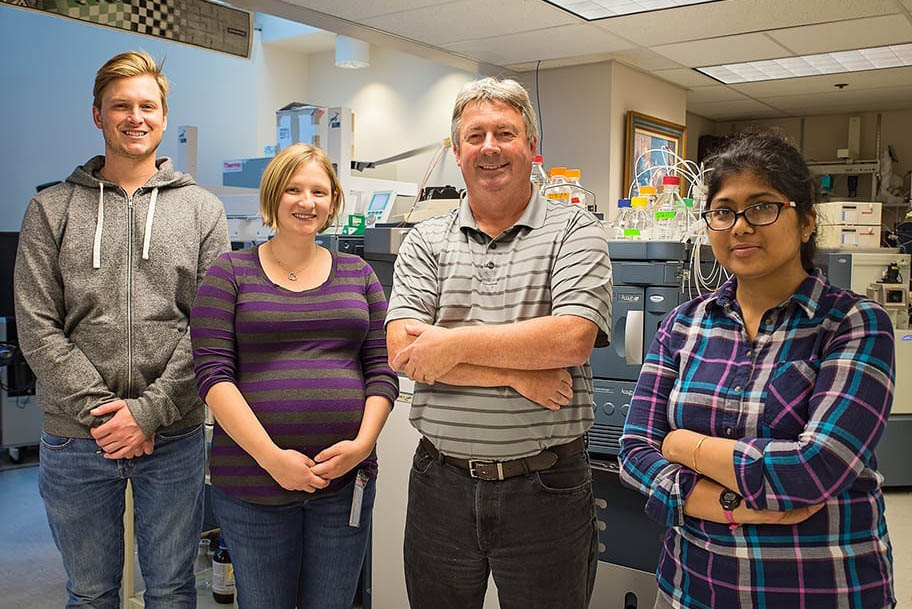
The Lee lab, L-R: Long Gui, Mike Guttman, Natalie Garcia, and Tad Davenport, discuss membrane fusion at a recent conference in Whistler, B.C.   Missing: Kelly Lee (or is he??)

 Kelly Lee Receives NIH Grant

Dr. Kelly Lee, Assistant Professor of Medicinal Chemistry, has been awarded a $1.45 million grant from the National Institutes of Health to study some of the more elusive but fundamental aspects of influenza virus membrane fusion. Dr. Lee will focus on determining what drives the fusion process, in addition to the nature of membrane deformations during fusion, which currently is not well understood.

Using electron cryotomography, small-angle X-ray scattering with 3-D shape reconstruction, and Hydrogen-Deuterium exchange with mass spectrometry analysis, the Lee lab will study the interplay between the hemagglutinin fusion protein, the viral matrix layer, and host cell membranes during fusion of the influenza virus with the host. In addition, through a variety of collaborations, the Lee lab is starting to investigate the mechanism of action of small molecule compounds that inhibit the fusion process.

"We're delighted to have received the NIH support, and look forward to learning a lot about the fundamental physical event, protein-mediated membrane fusion, that underlies cell invasion by an important human pathogen," said Kelly.

Congratulations to Kelly and the Lee lab on receiving support for this exciting research!


erinakatani Eri Nakatani Awarded Magnuson Scholarship

Med Chem graduate student Eri Nakatani (Carlos Catalano lab) has been awarded the prestigious Magnuson Scholarship for 2012. The University names six Magnuson Scholars annually, one from each of the health sciences schools.  Awardees are selected on the basis of academic performance and potential contributions to health sciences research.

As a Magnuson Scholar, Eri will focus on developing therapeutic nanoparticles derived from viral proteins. Her work involves the incorporation of an HIV-1 surface glycoprotein (gp160) into a water soluble, nanoscale lipid bilayer system (nanodiscs), which might someday be useful as an HIV vaccine. The project is a collaborative one involving the Catalano lab, Dr. Shiu-Lok Hu (Pharmaceutics), and Dr. Bill Atkins (Med Chem).

In addition, Eri is working on the thermodynamic characterization of the bacteriophage lambda capsid maturation process in vitro, under the guidance of Dr. Carlos Catalano, and with assistance from Dr. Kelly Lee (Med Chem). "Lambda virus has utility here as a model system for herpes viruses, but we also hope to use it as a platform for the development of targeted nanoparticles for use in therapeutics and/or diagnostics," Eri said.

"I am so honored to have received this opportunity to take my research to a new level and broaden my scientific horizons," said Eri. "I look forward to continuing my work on nanoparticle therapeutics and hope to obtain valuable feedback at conferences I might otherwise have been unable to attend."

Congratulations, Eri!


jeandinh Jean Dinh Appointed to Clinical Research (TL1) Training Grant

The Institute of Translational Health Sciences (ITHS) TL1 Multidisciplinary Predoctoral Clinical Research Training Grant is a year-long training experience funded by the National Institutes of Health (NIH) and the National Center for Research Resources (NCRR). The program allows grant recipients to work as part of an interdisciplinary team doing research that focuses on identifying major clinical problems, addressing these problems in the laboratory, and bringing bench discoveries into clinical practice. Jean Dinh (Rheem Totah lab) has recently received funding from this predoctoral training grant.

"I applied for the grant by submitting a proposal that addresses studying methadone pharmacokinetics with regards to CYP2B6 CYP3A4, and P-gp in healthy human subjects," said Jean. "The grant will help to support processing and analyses of the samples."

Congratulations, Jean!


Goodlett's SAWN Method to be Commercially Developed

Last year, Dr. Dave Goodlett's lab developed a method to make mass spectrometry research easier - Surface Acoustic Wave Nebulization (SAWN). With help from the UW Center for Commercialization, plans are to further develop the technology and make it commercially available. See all the exciting details in this article, written by Melinda Young, on the School of Pharmacy website.

Congratulations to Team Goodlett!


Sid Nelson Med Chem Mourns Beloved Professor and Dean Emeritus

 It is with great sadness that we report the death of Professor of Medicinal Chemistry Sidney D. Nelson, who passed away unexpectedly on December 9. Dr. Nelson, who was also Dean Emeritus of the School of Pharmacy, was admired and respected by everyone fortunate enough to know him, not only at our School but throughout the University and beyond.

Click this link to read the School of Pharmacy webpage honoring Dr. Nelson's many accomplishments, as well as providing details about his memorial service. An online guestbook has also been created at http://memorialwebsites.legacy.com/rememberingsid/Homepage.aspx if you would like to share your stories and memories of Dr. Nelson.

Sid, we miss you more than words can express.


triciazhao Grad Student Wins ISSX Poster Competition

Congratulations to Med Chem student Tricia (Chunsheng) Zhao, whose poster won second place in the predoctoral category at the 17th North American Regional ISSX conference in Atlanta, Georgia. Six finalists from each category were selected to present their posters during a poster viewing session at the conference, which ran from October 16-20. First, Second, and Third place awards were given at a special presentation event. Tricia is a member of Sid Nelson's lab. Good job, Tricia!


Read more: Latest News


Contact Us

Department of Medicinal Chemistry
University of Washington
HSB H-172, Box 357610
Seattle, Washington 98195
Phone: (206) 543-2224
Fax: (206) 685-3252
E-mail: This e-mail address is being protected from spambots. You need JavaScript enabled to view it

Go to directory ยป
   
image image image
What Research Opportunities Exist?
Our Mission
What is Medicinal Chemistry?
What Research Opportunities Exist? The faculty in Medicinal Chemistry offer diverse opportunities for study and research at the interface between chemistry and biology with emphasis on issues of biomedical importance. These include the role of phase I and II biotransformation processes in toxification and detoxification reactions, the metabolic consequences of phenotypic and genotypic diversity in the population, drug metabolism and enzyme kinetics, drug/drug and drug/herbal interactions, protein engineering, mechanisms of pathogen resistance, molecular modeling of peptides and proteins and vaccine development - to name but a few. In addition to specialized training acquired during their medicinal chemistry thesis work, graduates acquire a broad foundation in biochemistry, pharmacology and molecular biology which is important in the rapidly evolving, multidisciplinary biomedical arena.
Our Mission The goal of graduate program training in Medicinal Chemistry is to prepare highly trained, versatile individuals for a career in the pharmaceutical sciences; we are proud of our record of outstanding graduate students who now enjoy fruitful careers in academia, the pharmaceutical and biotechnology industries as well as with government and other regulatory agencies. If you are interested further in our Doctoral Program, please surf around our newly-designed web site and feel free to contact us directly if you require any additional information.
What is Medicinal Chemistry? Medicinal Chemistry is a discipline with a traditional focus on organic synthetic chemistry with the broad goals of drug discovery and optimization. The Department of Medicinal Chemistry at the University of Washington, since its inception in 1980, has always departed somewhat from this tradition given the focus of many of its faculty on the research areas of mechanistic drug metabolism, toxicology and bioanalytical chemistry. In recent years research activities in the Department have been broadened further by the addition of several faculty members with expertise in the areas of biological mass spectrometry and biophysical virology.
  • Contact Us
  • Admin
  • Intranet
  • Terms