On this page: Program Overview | Who Should Enroll | What You’ll Learn | Courses | Testimonials | Requirements & How to Apply | FAQs
Assess the Value of Healthcare Innovations
In this era of rapid medical innovation and high costs, the ability to evaluate emerging health technologies with rigor, clarity, and real-world insight has never been more essential.
The CHOICE Institute’s Certificate in Health Economics, Health Technology Assessment (HTA), and Market Access is designed for professionals engaged in the development, commercialization, appraisal, or evaluation of healthcare technologies—and who are ready to deepen their expertise.
You’ll master the economic principles that guide healthcare decision-making, the analytic methods that underpin robust economic evaluation, and the diverse approaches used by HTA bodies and payer organizations around the world.
Program Overview
This three-quarter, online program is part-time and flexible, ideal for full-time professionals. 
Whether you work in industry, government, academia, clinical practice, or consulting, this certificate will strengthen your ability to navigate the complex interplay between clinical evidence, cost-effectiveness, value assessment, and market access and pricing strategies.
You’ll gain both the conceptual grounding and practical tools to support high-quality decision-making and to contribute meaningfully to the evolving landscape of value-based healthcare.
Previously the Certificate in Health Economics and Outcomes Research (HEOR), this newly rebranded Certificate in Health Economics, Health Technology Assessment, and Market Access builds on the strengths of our legacy HEOR program. The core curriculum continues; the new name reflects the program’s scope and practical, job-relevant training tailored for working professionals in the current healthcare landscape.
Who Should Enroll
Professionals in healthcare, biomedical technology, or life sciences industries who want to be better prepared to inform evidence and value generation decisions within their companies as well as resource allocation, coverage, pricing, and policy decisions for payers and other stakeholders.
You’ll enhance skills for current positions, expand opportunities within your organization, and better understand concepts for cross-organization collaborations.
Students come from a variety of roles, including:
- Market access and pricing specialists

- Medical science liaisons
- Medical affairs and health economics & outcomes research (HEOR) directors
- Pharmacists and PharmD researchers
- Researchers from non-HEOR fields
- Healthcare providers
- Payers
- Medical and science writers
- Healthcare consultants
- Healthcare policy analysts
What You’ll Learn
- Key economic principles of healthcare markets and the incentives that shape innovation and resource allocation
- Methodological foundations in cost-effectiveness analysis, budget impact modeling, and economic evaluation
- Real-world considerations that influence coverage, reimbursement, pricing, and market access decisions
- International practice of health technology assessment (HTA) frameworks and health systems
Program Structure (3 Quarters)
Online and asynchronous, this 9-month program conveniently fits around your work schedule.
Complete three courses—one class per quarter—to earn the certificate:
Quarter 1 Dates—Autumn
September 30, 2026—December 18, 2026
About this Course
This course introduces students to the principles of economics as applied to health sector markets. We’ll explain the foundational principles of economics as well as the features of health sector markets that make them unique. We’ll also consider the principles of supply and demand for medical care and health insurance and look at how private and public health care markets are regulated. We’ll use contemporary examples to illustrate the key challenges facing health care systems.
What You’ll Learn
- The importance of health care insurance and its public versus private provision
- The economics of pharmaceutical markets and how these markets are regulated
- The sources of market and government failures and how they affect the healthcare sector
- The economics of personalized medicine and of patient-centered comparative effectiveness research
- The economic markets of different medical services, such as hospitals, physicians and non-physician providers
Course Instructors


Cost
Course Fee: $2,835
Quarter 2 Dates—Winter
January 4, 2027—March 19, 2027
About this Course
This course introduces students to economic evaluation in healthcare, specifically cost-effectiveness analysis of pharmaceuticals, devices, and other healthcare interventions. We’ll cover topics such as methods for economic evaluation in healthcare, decision modeling, preference measures, and the development of coverage and reimbursement policies using cost-effectiveness data. We’ll also teach introductory spreadsheet modeling and use contemporary examples from the literature to illustrate key concepts.
What You’ll Learn
- The role of economic evaluation in healthcare decision-making and health policy
- How to assess the strengths and weaknesses of different methods for economic evaluation in healthcare
- How to understand cost and outcomes modeling techniques for economic evaluation
- How to create an introductory decision analysis model using spreadsheet software
- How to critically evaluate cost-effectiveness studies
Course Instructors


Cost
Course Fee: $2,835
Quarter 3 Dates—Spring
March 29, 2027—June 11, 2027
About this Course
Innovations in healthcare – such as drugs, diagnostic tools and medical devices – can improve patients’ lives if they are safe, effective, economical and readily available. Health stakeholders use global health technology assessments (HTAs) to determine the clinical and cost-effectiveness of health technologies and to ensure market access for patients.
The field of HTA uses evidence synthesis methods to create inputs used in economic models that inform HTA decision-making. For the healthcare industry, market access involves developing strategies for medical product registration, technology assessments by local entities, pricing, and reimbursement methods.
This course introduces students to the principles, methods, and practices of global HTA and market access, from evidence synthesis to decision-making. We’ll present various approaches to organizing and conducting HTA, using examples from around the world. You’ll examine contemporary case studies and interviews with global HTA leaders to understand the processes used to evaluate evidence and make resource allocation decisions about health technologies. We’ll describe and discuss various market access instruments, including price negotiation, innovative access agreements and international price referencing.
What You’ll Learn
- The organization, processes, and conduct of HTA bodies around the world
- How to synthesize and appraise evidence to support reimbursement and coverage decisions
- Ways to evaluate the role of thresholds, decision rules, and novel financial access agreements by HTA agencies in the current environment
- How to understand and navigate the complexities of international price referencing arrangements
- Techniques for describing the emerging price negotiation environment in the United States
Course Instructors


Cost
Course Fee: $2,835
Courses are:
- Online
- Asynchronous
- Self-paced
Course content includes:
- Pre-recorded lectures
- Readings
- Discussion forums
- Quizzes
- Group capstone project
- Two virtual group meetings with instructor and teaching assistant (optional to attend)
- Optional networking activity
- Average time commitment: 5-6 hours per week
Why This Certificate Stands Apart
Learn from the Experts
Certificate courses are taught by world-class faculty at The Comparative Health Outcomes, Policy, and Economics (CHOICE) Institute, housed within the University of Washington School of Pharmacy.  Course instructors are leaders in shaping policy, developing innovative assessment tools, and transforming health economics and outcomes research.
The program also features interviews with HTA experts from around the world—distinguished policy makers and scholars in health technology assessment.
Get Hands-On Experience
You’ll complete a group capstone project to assess a health system and the landscape of health technology assessment processes in a specific country.
The purpose of the capstone project is to apply tools and concepts gained from all three courses to develop a portfolio of one country’s healthcare system, focusing on the financing and heath technology assessment processes within that country.
- Groups and countries are assigned in the first course.
- Group size is four to six students.
- Students work in their same group all three quarters.
- Country assignments for the 2026-2027 year are Australia, Brazil, France, Germany, South Korea, the United Kingdom, and the United States.
- Quarterly project assignments relate to course lessons.
- At the end of spring quarter, groups compile their quarterly projects into a final written report.
Recommended By Students
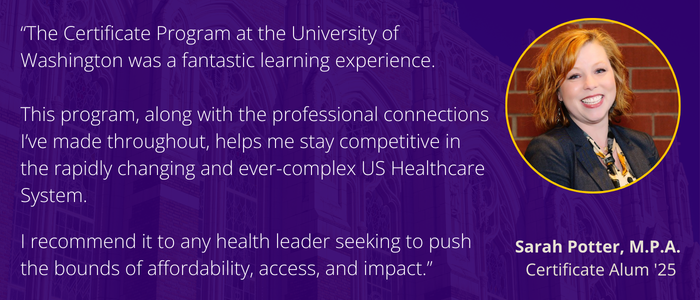
The Certificate Program at the University of Washington was a fantastic learning experience. This program, along with the professional connections I’ve made throughout, helps me stay competitive in the rapidly changing and ever-complex US Healthcare System. I recommend it to any health leader seeking to push the bounds of affordability, access, and impact.

I love the self-paced aspect of the courses, but also appreciate the scheduled check-ins with the professors. I was told that one of the main reasons I secured an HEOR role in the pharmaceutical industry was because I took the initiative to take this HEOR certification and was taught by thought leaders in the HEOR space.

The HEOR certificate program deepened my understanding in health economics providing a strong foundation for strategic decision-making in my role. I gained practical skills in pharma economics and economic modeling that I apply directly to my ongoing projects.


Program Requirements & How to Apply
Required
To apply, you must have a bachelor’s degree.
Recommended
- Experience or education in the healthcare system
- Familiarity with undergraduate-level statistical methods and algebra
- Ability to work successfully in diverse team environments and participate as a contributing member of an assigned team to complete a capstone project
English Proficiency
If English is not your primary language, you should have at least intermediate English skills to enroll: B2 level on the CEFR self-assessment grid. This is a self-assessment. No language tests are required. To learn more, review English Language Proficiency Requirements – Noncredit Programs.
International Students
This certificate is 100% online and can be completed from any location. No visa is required and international students are welcome to apply. This program cannot provide I-20s or DS-2019s for student visas due to its online, part-time format.
Technology Requirements
You must have access to a computer with a high-speed internet connection.
Earning the Certificate
Earn the certificate of completion and nine continuing education credits (CEUs) by successfully completing all required courses. For more information, review Earning the Certificate.
How to Apply
Timeline
- Applications open: April 16, 2026
- Application deadline: September 16, 2026
- Next program start date: September 30, 2026
Application Steps
- Prepare:
- Brief letter (250-word maximum) describing relevant experience, transferable skills, knowledge of the field, and commitment to professional growth
- Resume highlighting how your education and any applicable experience fulfill the program’s admission requirements.
- Apply online (copy and paste the materials from Step 1 into the online form)
- Pay the $50 nonrefundable application fee.
(Payment link will be emailed to you one to two business days after application submission).
After Applying
Admissions decisions are emailed within two weeks after your application date.
Related Resources
FAQs
- There are two optional Zoom meetings each quarter for faculty and students to meet and discuss questions as a group.
- There is an optional online networking activity each quarter, designed for students to connect with peers.
- The group capstone project provides a beneficial opportunity for students to connect.
This is a noncredit certificate and does not offer college credit. It offers Continuing Education Units (CEUs), a nationally recognized standard for documenting successful completion of noncredit continuing education courses. Students earn 3 CEUs per quarter for a total of 9 CEUs for the certificate.
This certificate is offered in collaboration with University of Washington Professional & Continuing Education (PCE).
Yes! Learn more about library services for UW Professional & Continuing Education (UW PCE) students.
Courses are graded on a SC/USC (successful completion/unsuccessful completion) basis. Your grade, along with CEUs earned, appears on your UW Professional & Continuing Education record.
We estimate students spend approximately 5-6 hours per week on course activities.
We use Excel for modeling in this program. Some other tools are introduced, like Markov models and microsimulations, but we do not delve into more complex, advanced modeling with other programming languages.
- Enhance skillsets for current roles, gain improved knowledge, confidence, and tools for evidence-based decision-making.
- Expand skills for professional transitions within the health field—providers interested in policy roles, for example, or medical science liaisons transitioning to a field HEOR representative position.
- Gain a deeper understanding of health economics and outcomes research (HEOR), health technology assessment (HTA), real-world evidence (RWE), and market access to better collaborate with cross-organization teams.
- In some cases, consider a larger career pivot and gain entry into health system analysis roles. Graduate degrees may be needed for a larger career change, but this certificate can help you explore the different components of health economics and HTA and provide a foundation for further study.
- Network and make connections with course peers and faculty.
- Become part of the CHOICE community and receive Institute updates and invitations to the annual social gathering at ISPOR.
- Students have shared that the connections made and the recognition of this certificate opened new opportunities and made them stronger candidates in the job market.
Costs & Fees:
- $50 application fee (one time)
- $55 registration fee per quarter
- $2,835 course fee per quarter ($8,505 total)
Payment options:
- Electronic check
- Credit or debit card
- Bank check or money order
- Third-party payments
For more details, review the payment options information.
Students who successfully complete all three courses will receive a paper certificate by mail and a digital badge, along with 9 Continuing Education Units (CEUs).
This program, the Certificate in Health Economics, Health Technology Assessment, and Market Access, introduces students to a variety of concepts and tools critical to healthcare resource allocation and decision-making:
- Economic principles in the unique context of health sector markets
- Different methods for synthesizing evidence and conducting economic evaluation in healthcare
- How to assess the clinical and cost-effectiveness of health technologies like drugs, diagnostic tools, and medical devices, and ensure these innovations get to patients
- International practice of health technology assessment (HTA) frameworks and health systems
The Certificate in Data Science Methods for Real-World Evidence in Health covers fundamental data science concepts and methods, including statistics and machine learning, in the context of health data analytics:
- Evaluating real-world data sources
- Topics in statistics, epidemiology, and evidence synthesis
- How causal inference supports comparative effectiveness
- When to trust regression, machine learning, or hybrid approaches
- How to choose covariates and interpret outputs
- How data science supports policy, pricing, and access decisions
- How to frame meaningful research questions and understand how methodological choices shape conclusions
This certificate builds on the strengths of our legacy HEOR program. The core curriculum continues; the new name better reflects the program’s scope and practical, job-relevant training tailored for working professionals in the current healthcare landscape.
Yes! Your certificate remains valid and recognized. You are part of the program’s legacy and the UW CHOICE community, and your credential continues to hold the same professional value.
Ready to Move Forward?
Help shape a future where health technologies are assessed with integrity, transparency, and scientific rigor.