On this page: Program Overview | Testimonials | Who Should Enroll | What You’ll Learn | Courses | Requirements & How to Apply | FAQs
Understand the Science of Interrogating Health Data
The CHOICE Institute’s Certificate in Data Science Methods for Real-World Evidence (RWE) in Health will strengthen your skills to confidently evaluate and interpret health data.
Healthcare and life-science organizations generate vast amounts of real-world data—from electronic health records and claims to registries, device data, genomic profiles and patient-reported outcomes. Yet the true value of this data often remains unrealized.
This certificate helps decision-makers understand what these data can (and cannot) tell us, how to choose and trust analytic methods, and how to translate results into sound decisions.
Program Overview: Turn Data Into Insights
The Challenge
Across health systems and biomedical organizations leaders rely on data science teams to guide decisions about product development, pricing, access, safety, and clinical strategy. 
Yet often those who review and act on these analyses have never been trained to evaluate the assumptions behind statistical models, recognize bias and confounding, or distinguish correlation from causal evidence.
The risk? Costly mistakes. Analyses can be misinterpreted, overgeneralized, or used in ways that don’t reflect the limits of the data.
The Solution
This certificate is designed to help you bridge the gap between technical analytics and organizational decision-making.
Drawing on real healthcare examples, this certificate emphasizes the why, when, and how of data science in health:
- Why a particular analytic method is appropriate for a given research question
- When its results should (and should not) be trusted
- How findings can be interpreted to inform real-world decisions in clinical, regulatory, and commercial settings
Formerly the Certificate in Data Science in Health Economics and Outcomes Research (HEOR), this newly rebranded Certificate in Data Science Methods for Real-World Evidence (RWE) in Health continues to equip professionals with the tools to gain valuable insights from health data. While the core curriculum continues, the new name highlights the program’s scope and application in today’s health data landscape.
Recommended by Students and Industry Experts
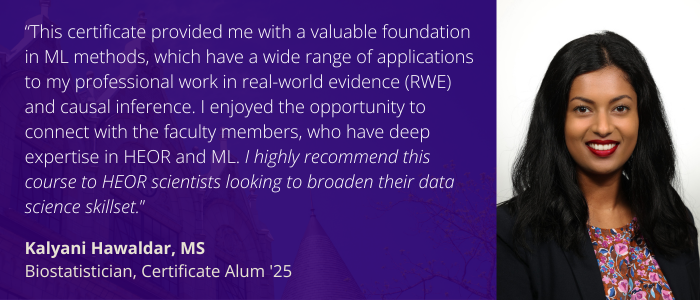
The certificate provided me with a valuable foundation in ML methods, which have a wide range of applications to my professional work in real-world evidence (RWE) and causal inference. I enjoyed the opportunity to connect with the faculty members, who have deep expertise in HEOR and ML. I highly recommend this course to HEOR scientists looking to broaden their data science skillset.

Mastery of advanced data science in HEOR is more important than ever. This certificate meets the growing demand for such expertise, making graduates highly sought after in the evolving HEOR field.

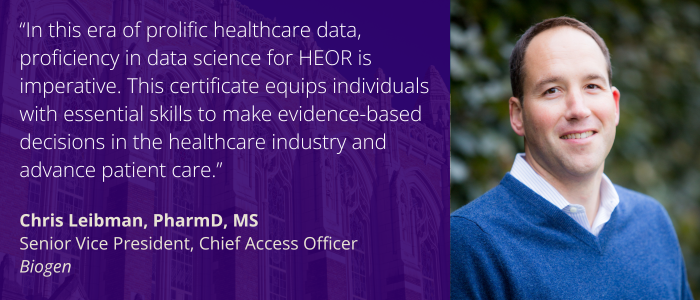
In this era of prolific healthcare data, proficiency in data science for HEOR is imperative. This certificate equips individuals with essential skills to make evidence-based decisions in the healthcare industry and advance patient care.

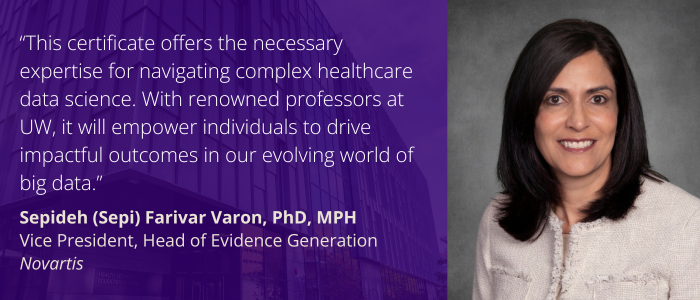
This certificate offers the necessary expertise for navigating complex healthcare data science. With renowned professors at UW, it will empower individuals to drive impactful outcomes in our evolving world of big data.


Who Should Enroll
Designed for professionals in:
- Pharmaceutical and biotechnology companies
- Health systems, payers, and policy organizations
- Medical device and diagnostics firms
- Government and regulatory agencies
Ideal for roles such as:
- Health economics and outcomes research (HEOR) and market access leaders
- Real-world evidence (RWE) analysts
- Medical science liaisons
- Product and strategy managers
- Data scientists and data science collaborators
- Graduate-level researchers
This certificate is especially relevant if you manage data scientists, collaborate with analytics teams, or make evidence-based decisions. You’ll better assess credibility and communicate findings effectively.
What You’ll Learn
- How to evaluate real-world data sources like claims, electronic health records (EHRs), and registries
- How causal inference supports comparative effectiveness
- When to trust regression, machine learning, or hybrid approaches
- How to choose covariates and interpret outputs
- How data science supports policy, pricing, and access decisions
- How to frame meaningful research questions and understand how methodological choices shape conclusions
Program Structure (3 Quarters)
Online and asynchronous, this 9-month program conveniently fits around your work schedule.
Complete three courses—one class per quarter—to earn the certificate:
Quarter 1 Dates—Autumn
September 30, 2026 – December 18, 2026
About this Course
This course provides an overview of important aspects of data science. We’ll cover types of data and data management strategies, evidence gathering and synthesizing approaches, as well as how to conduct analyses using statistical and epidemiologic concepts. We’ll prepare for future courses with an introduction to machine learning (ML).
What You’ll Learn
- Introductory data science concepts
- How to manage real-world data, including data from claims and electronic health records
- Introductory concepts in statistics, including probability, distribution, and regression
- Topics in epidemiology and evidence synthesis, including systematic reviews and meta-analysis, and the role of artificial intelligence in this field
Course Instructor

Cost
Course Fee: $2,835
Quarter 2 Dates—Winter
January 4, 2027 – March 19, 2027
About this Course
In this course, you’ll learn introductory principles of causal inference, which is the basis for comparative-effectiveness research. You’ll also learn about a wide range of causal inference methods, the underlying differences, and applications in health economic and outcomes research.
What You’ll Learn
- Introductory concepts in causality, how to choose among covariates, and regressions for outcomes
- How to analyze healthcare expenditure data
- Regressions for utilizations, count data and survival outcomes
- Methods for evaluating policy and estimating causal treatment effects and projections using real-world data
- How to understand and analyze longitudinal or panel data
Course Instructor

Cost
Course Fee: $2,835
Quarter 3 Dates—Spring
March 29, 2027 – June 11, 2027
About this Course
In this course, we’ll introduce you to machine learning (ML) methods, with a focus on high-level concepts and examples from literature in the field of health economics and outcomes research (HEOR). We’ll explore the use of machine learning for making medical decisions, informing health policy, and evaluating health economics.
What You’ll Learn
- Introductory concepts in machine learning
- How to apply machine learning to the HEOR landscape
- Differences between supervised vs. unsupervised learning and prediction vs. causal inference
- Introductory concepts in algorithmic fairness, model drift, and generalizability
- How machine learning is used in simulation modeling
Course Instructor

Cost
Course Fee: $2,835
Courses are:
- Online
- Asynchronous
- Self-paced
Course content includes:
- Pre-recorded lectures
- Readings
- Discussion forums
- Quizzes
- Individual capstone project each quarter
- Reading assignment + short essay questions
- Two virtual group meetings with instructor and teaching assistant (optional to attend)
- Optional networking activity
- Average time commitment: 5-6 hours per week
Why This Certificate Stands Apart
Most programs focus on software. This one focuses on insight.
Our hallmark approach emphasizes:
- Key statistical concepts and assumptions
- How methods differ—and when they fail
- Real-world applications in healthcare, health economics & outcomes research (HEOR), and policy
- Practical interpretation of results for decision-making
 You’ll learn to critically evaluate evidence, assess model credibility, and confidently engage with analytics teams—without needing to become a programmer or statistician.
Certificate courses are taught by world-class faculty at The Comparative Health Outcomes, Policy, and Economics (CHOICE) Institute, housed within the University of Washington School of Pharmacy. Course instructors are leaders in shaping policy, innovation, and developing tools to advance evidence-generation and healthcare decision-making.
Program Requirements & How to Apply
Requirements
To apply, you must have:
- A bachelor’s degree in a related field
- Experience or education in health care
- Basic familiarity with undergraduate-level statistical methods and algebra
English Proficiency
If English is not your primary language, you should have at least intermediate English skills to enroll: B2 level on the CEFR self-assessment grid. This is a self-assessment. No language tests are required. To learn more, review English Language Proficiency Requirements – Noncredit Programs.
International Students
This certificate is 100% online and can be completed from any location. No visa is required and international students are welcome to apply. This program cannot provide I-20s or DS-2019s for student visas due to its online, part-time format.
Technology Requirements
You must have access to a computer with a high-speed internet connection.
Earning the Certificate
Earn the certificate of completion and nine continuing education credits (CEUs) by successfully completing all required courses. For more information, review Earning the Certificate.
How to Apply
Timeline
- Applications open: April 16, 2026
- Application deadline: September 16, 2026
- Next program start date: September 30, 2026
Application Steps
- Prepare:
- A brief letter (250-word maximum) describing your relevant experience, transferable skills, knowledge of the field, and commitment to professional growth
- A resume highlighting how your education and any applicable experience fulfill the program’s admission requirements
- Apply online (copy and paste materials from Step 1 into the online form)
Applications Open April 16, 2026 - Pay the $50 nonrefundable application fee. (Payment link will be emailed to you one to two business days after application submission).
After Applying
Admissions decisions are emailed within two weeks after your application date.
Related Resources
Frequently Asked Questions
- There are two optional Zoom meetings each quarter for faculty and students to meet and discuss questions as a group.
- There is an optional online networking activity each quarter, designed for students to connect with peers.
This is a noncredit certificate and does not offer college credit. It offers Continuing Education Units (CEUs), a nationally recognized standard for documenting successful completion of noncredit continuing education courses. Students earn 3 CEUs per quarter for a total of 9 CEUs for the certificate.
This certificate is offered in collaboration with University of Washington Professional & Continuing Education (PCE).
Yes! Learn more about library services for UW Professional & Continuing Education (UW PCE) students.
Courses are graded on a SC/USC (successful completion/unsuccessful completion) basis. Your grade, along with CEUs earned, appears on your UW Professional & Continuing Education record.
We estimate students spend 5-6 hours per week on course activities.
You will have the opportunity to learn the basics of R and its Integrated Development Environment – R Studio. The certificate mainly emphasizes methodological insight and does not include coding in its required lessons, but through our optional training module you can learn the fundamentals of manipulating datasets, working with objects, performing simple statistical tests, creating basic visualizations, saving data, and preparing reports with Quarto.
- Enhance skillsets for current roles.
- Gain improved knowledge, confidence, and tools for evidence-based decision-making.
- Network and make connections with course peers and faculty.
- Become part of the CHOICE community and receive Institute updates and invitations to the annual social gathering at ISPOR.
Costs & Fees:
- $50 application fee
- $55 registration fee per quarter
- $2,835 course fee per quarter ($8,505 total)
Payment options:
- Electronic check
- Credit or debit card
- Bank check or money order
- Third-party payments
For more details, review the payment options information.
Students who successfully complete all three courses will receive a paper certificate by mail and a digital badge, along with 9 Continuing Education Units (CEUs).
This program, the Certificate in Data Science Methods for Real-World Evidence in Health, covers fundamental data science concepts and methods, including statistics and machine learning, in the context of health data analytics:
- Evaluation of health data
- Topics in statistics, epidemiology, and evidence synthesis
- Comparative effectiveness research and causal inference
- How machine learning is applied to complex data analysis to gain insights and inform decision making
The Certificate in Health Economics, Health Technology Assessment, and Market Access introduces students to a variety of concepts and tools critical to healthcare resource allocation and decision-making:
- Economic principles in the unique context of health sector markets
- Different methods for economic evaluation in healthcare
- How to assess the clinical and cost effectiveness of health technologies like drugs, diagnostic tools, and medical devices, and ensure these innovations get to patients
- International practice of health technology assessment (HTA) frameworks and health systems
This certificate builds on the strengths of the previous program. The core curriculum continues; the new name better reflects course content and its application in today’s professional healthcare landscape.
Yes! Your certificate remains valid and recognized. You are part of the program’s legacy and the UW CHOICE community, and your credential continues to hold the same professional value.
Ready to Move Forward?
Maximize data’s potential to improve healthcare decision making.