Matt Binder on Ownership, Mentorship, and Community Care
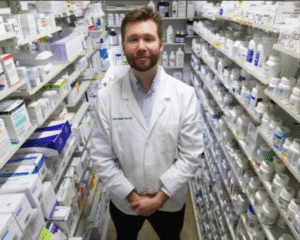 As independent pharmacies across the region continue to disappear, Matt Binder (‘17) is helping keep a different model of care alive. As the owner of four independent pharmacies in King County, he has welcomed patients displaced by closures while building practices where people are known—where staff stay, students learn by doing, and relationships shape how care is delivered.
Today, his organization employs 21 students on payroll, not counting those preparing to join. He currently precepts multiple UW PharmD students each year across introductory and advanced practice experiences, integrating them directly into daily operations. His approach is deliberate and deeply local, grounded in the belief that pharmacy still works best when it remains human.
In recognition of that commitment, Binder was named the 2025 National Preceptor of the Year by the NCPA Foundation—a distinction honoring his role in shaping the next generation of pharmacists through hands-on mentorship and personal investment in students’ growth.
Finding a Calling in Pharmacy
Binder’s path into pharmacy began without a master plan. As a student at Cascadia College, he was working through general coursework when chemistry caught his attention. Pharmacy, he realized, offered something rare: the chance to be a health care provider grounded in deep scientific training while remaining directly connected to patients and community.
The University of Washington made that path possible—not only academically, but relationally.
“UW gave me a really strong education,” he says. “But just as importantly, it introduced me to mentors who helped me see what leadership could look like in this profession.”
Faculty mentors including Nanci Murphy, Micki Kedzierski, Peggy Odegard, Ryan Hansen, Dana Hammer, Sean Sullivan, and Jenny Arnold encouraged him to think beyond his first job and toward long-term contribution. They challenged him to develop confidence, to speak up, and to consider ownership as attainable.
SOP alum Don Downing’s pharmacy advocacy course proved especially formative, and Legislative Day, in particular, shifted his perspective.
“It convinced me that we can make a difference and advocate for ourselves,” Binder says. Downing also helped him think through post-graduation opportunities. “He really helped me talk through what ownership could look like.”
Stepping Into Ownership
After working as an intern at Woodinville Pharmacy and later joining Ostrom’s Drug & Gift in Kenmore, Binder faced a defining decision when the longtime owner began planning for retirement.
“If I wasn’t the person to step in,” he recalls, “the store could have been sold to a chain—or closed altogether.”
Ownership was not simply a business move. It was stewardship. A way to preserve jobs, maintain continuity of care, and protect a model of practice he believed in.
He also understood he was joining a long tradition. UW School of Pharmacy graduates have quietly shaped community pharmacy ownership across Washington State for decades. Binder now stands among that line—graduates who chose not only to practice pharmacy, but to build and sustain it.
He credits UW directly for preparing him for that step.
“The clinical training was strong,” he says. “But just as important were the mentors and the exposure to advocacy and leadership. I felt prepared to take on ownership because I had seen examples of it—and had people who encouraged me to consider it seriously.”
For prospective students considering the profession, ownership, he believes, remains one of pharmacy’s most meaningful and demanding paths. It requires clinical skill, business judgment, and long-term commitment to community—but it also offers autonomy and the opportunity to shape culture intentionally.
Growth since then has been steady. As other pharmacies in the Seattle area have closed, Binder’s stores have absorbed displaced patients. Expansion has been measured, guided by a clear priority.
“We’re trying to keep the same high quality of care for every patient,” he says.
Culture, he believes, must be taught deliberately and protected intentionally.
Why Independent Pharmacy Endures
Independent pharmacy succeeds, Binder believes, because it is built on continuity. Some employees have remained for decades. Patients are recognized the moment they walk in. Medication synchronization appointments allow pharmacists to slow down, review regimens, and intervene early. Walk-in vaccinations are routine. Conversations are unhurried.
“It’s that personal touch,” Binder says. “People feel it.”
He sees his stores not simply as retail spaces, but as steady points in neighborhoods that are otherwise changing quickly.
Teaching the Next Generation
If ownership is stewardship of community, precepting is stewardship of the profession.
Binder has been precepting for nine years. Most of his students have come from the University of Washington, and he currently mentors several UW PharmD students each year. He says he has been happy with everyone who has come through his pharmacies.
Students are not observers; they are contributors. They learn workflow, patient counseling, vaccination delivery, insurance navigation, and the realities of running a small business. They see how staffing decisions are made, how culture is built, and how advocacy connects to daily practice.
Binder has taken great pride in watching student leadership evolve. Seeing students like Dandan Johannessen and Caitlin Lazaro help revitalize UW’s NCPA chapter has been particularly meaningful. Recently, he wrote to colleagues reflecting on how far UW’s relationship with community pharmacy has come.
“Students have never seemed more excited to learn what we’re doing in the community and independent realms,” he says.
A School in Motion
Binder is encouraged not only by students, but by the faculty shaping them.
He points to a new generation of professors—Lisa Garza, Jenny Bacci, Brenna Molato, Abby Winter, Laura Hart, James Lin, Rachel Allen, among others—whose focus on community pharmacy development is visible from outside the classroom.
“Their passion for teaching is apparent,” he says.
For someone whose own trajectory was shaped by mentorship, that continuity matters. It signals that ownership and community practice remain part of the School’s evolving identity.
A Quieter Counterpoint
In a health care landscape defined by consolidation and speed, Matt Binder’s work offers a steady counterpoint—one built on continuity, mentorship, and belief in local care.
His pharmacies continue to grow. His students continue to arrive. And ownership, for him, remains less about expansion than about responsibility: to patients, to employees, and to the profession that shaped him.
Care, he believes, works best when it remains personal.
About Matt Binder
Matt Binder received his PharmD from the University of Washington School of Pharmacy in 2017. He serves on the School’s Pharmacy Alumni Association Board and is the owner of Ostrom’s Drug & Gift (Kenmore), Woodinville Pharmacy, and two additional independent pharmacies in King County.