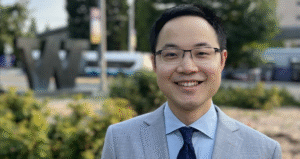
 At the UW School of Pharmacy, Shijie Cao leads the PRIME Lab (Pharmaceutical Research in Immune & Microbiome Engineering Laboratory), who are studying how signals from the gut microbiome shape human health—and how that knowledge could help guide better treatments for chronic inflammatory disease.
Deep in the gut, trillions of bacteria are carrying out work essential to human health. They help break down food, support the body’s defenses and send signals that scientists are still only beginning to understand. Invisible as they are, these microbial communities may influence far more than digestion. They may also shape inflammation, immunity and the body’s ability to stay in balance.
For Shijie Cao, Ph.D., that hidden world is a place of both mystery and possibility.
Cao, an assistant professor in the University of Washington School of Pharmacy’s Department of Pharmaceutics, studies the gut microbiome and the compounds it produces. His lab is working to better understand how those microbial signals affect health—and how that knowledge could one day help researchers design therapies that are more precise, more durable and easier for patients to live with.
That work recently received a major boost through a National Science Foundation CAREER award, Developing Synthetic Microbiome Mimics to Study Microbe-Host Interactions. Through the award, Cao’s team is developing novel bio-mimics designed to recreate key signals normally produced by beneficial gut bacteria, allowing researchers to study how microbial components influence immune responses and intestinal health in more precise and controlled ways.
A MORE PRECISE WAY TO STUDY A COMPLEX SYSTEM
One of the central challenges in microbiome research is complexity. Scientists know that gut bacteria produce compounds that help support the gut lining and regulate the immune system. But it is often difficult to isolate the role of any one signal, understand what happens when those signals are disrupted or determine how those changes may contribute to disease.
Studying live bacteria can also be unpredictable. Results may depend on whether particular strains survive in the body, grow as expected or interact with other microbes in ways that are difficult to control.
To address that challenge, Cao’s lab is developing synthetic microbiome mimics—tiny engineered particles designed to imitate some of the helpful signals bacteria naturally produce. These tools make it possible to ask clearer questions about cause and effect: which signals matter, where they act and how they may influence health over time.
The goal is not simply to better understand the microbiome. It is to use that understanding to help guide future treatment.
KEEPING PATIENT IMPACT IN VIEW
Cao’s lab is especially interested in inflammatory and immune-related conditions, including allergies and autoimmune diseases such as multiple sclerosis. For many patients, these are long-term conditions that shape daily life in quiet but persistent ways. Treatments may help, but they can also bring side effects, limitations or the burden of ongoing use.
Cao hopes his work will help lay the foundation for therapies that are more targeted and easier for patients to live with over time.
“Our goal is to use these tools to better understand how the microbiome shapes health,” Cao said. “From there, we hope to develop therapies that can target those pathways in meaningful ways.”
That translational focus runs throughout the lab’s work. Alongside the synthetic mimics, Cao’s team is also using computational models to predict where these particles travel in the body and how they behave once they get there. Together, those approaches could help researchers better understand how microbiome-derived signals shape health—and how future therapies might work more effectively with the body’s own biology.
BUILDING TOWARD WHAT COMES NEXT
The field is still relatively young, and many of its biggest questions remain unanswered. That uncertainty is part of what drew Cao to it. His work brings together drug delivery, immunology and microbiome science, with an emphasis on building tools that can move basic research toward practical use.
The CAREER award will also support a broader educational and outreach mission, including the development of new course modules, interdisciplinary workshops, and mentored research experiences for students from a wide range of academic backgrounds.
In collaboration with UW Microbial Interactions & Microbiome Center and the UW Engineering Academy, Cao also hopes to expand outreach in immune and microbiome engineering for K–12 students, helping introduce younger learners to how engineering and biomedical science can work together to address human health challenges.
Together, these efforts are intended to strengthen interdisciplinary training, foster collaboration across traditionally separate fields and help prepare the next generation of scientists to work at the intersection of microbiome science, immunology and engineering. For now, Cao’s lab is focused on building better ways to study one of the body’s most complex systems. In time, that work could help create a clearer path to therapies that are not only more precise, but more useful in the lives of patients.