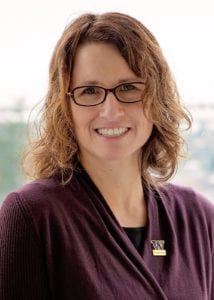
 Dr. Shelly Gray, Professor and Elmer and Joy Plein Endowed Director of the Plein Center for Aging, has returned from sabbatical, where she completed a six-month Fulbright U.S. Scholar fellowship at China Medical University (CMU) in Taichung, Taiwan. While abroad, Gray focused her research on whether commonly prescribed medications contribute to sedentary behavior and reduced physical activity in older adults. Gray’s project, “Adverse Drug Effects of Medication Use on Sedentary Time and Physical Activity in Older Adults,” builds on her research program in optimizing medication use to support healthy aging.
Gray’s work addresses a gap in understanding the downstream effects of polypharmacy, the common practice of prescribing more medications than a patient needs. Many CNS-active drugs, such as sedatives, cause dizziness, drowsiness and reduced attention, and while these effects are well documented as fall risks, Gray suspected a more subtle “pre-fall” impact. “We understand that sitting is the new smoking, but we lack a clear understanding of whether medications may be promoting this inactivity,” she said. “I wanted to know whether these medications make older adults so fatigued that they simply reduce their movement.”
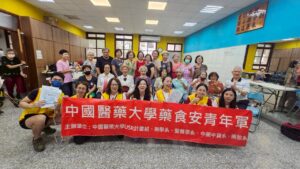
Taiwan, where more than 20% of the population is age 65 or older, offered Gray a rare vantage point on that question. “Taiwan is a ‘super-aging’ society,” Gray said. “It provided the ideal laboratory to investigate this question, supported by a world-class healthcare infrastructure.” Her host, Professor Hsiang-Wen Lin of CMU, is an expert in pharmacoepidemiology whose research closely aligned with Gray’s own. The collaboration expanded to include Professor Edward Chia-Cheng Lai and Daniel Hsiang-Te Tsai of National Cheng Kung University (NCKU), with the team drawing on Taiwan’s national healthcare databases to conduct granular, longitudinal analyses of medication harms and compare findings between Taiwanese and American populations.
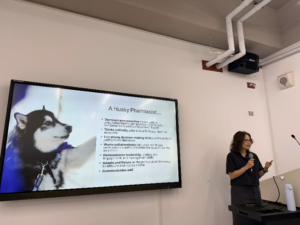
Beyond her own research, Gray mentored pharmacy graduate students through a systematic review on medications and sedentary time, presented at five professional pharmacy conferences across Taiwan, and gave four additional talks to students and faculty at CMU. She submitted three journal articles during her fellowship and has three more manuscripts in progress.
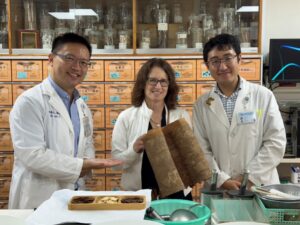
Gray’s fellowship also opened new avenues for research on rural health equity. A meeting with Dr. Chen-Yu Wang and colleagues at the National Center for Geriatrics and Welfare Research introduced her to their work using community centers to optimize medication use in Taiwan’s aging rural communities, an approach that resonated with her own commitment to health equity. That conversation has already led to plans for continued collaboration on fall prevention: Gray will return to Taiwan in October 2026 to deliver a keynote presentation at the International Conference of Healthy Ageing and Community Resilience, hosted by Taiwan’s National Health Research Institutes (NHRI).
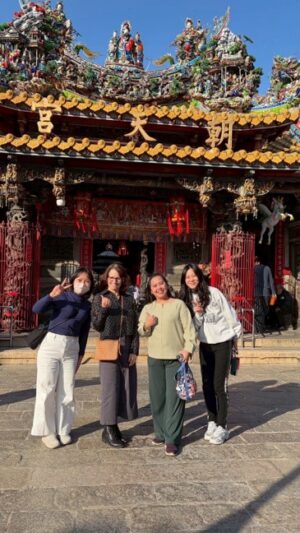
Looking back on her six months abroad, Gray said the collaborations she built extended well beyond the data. “Although I did encounter challenges with not speaking Mandarin, I discovered that true communication often lives in the space between words,” she said, “in the warmth of a shared meal, listening to people’s life stories, and laughter among new friends.”