Research has established that people with diabetes face a higher risk of Alzheimer’s disease and related dementias (ADRD). That makes diabetes management a promising way to reduce the burden of ADRD on patients, caregivers, and the health system.
In a new article published in Alzheimer’s & Dementia, CHOICE Institute faculty Drs. Douglas Barthold and Anirban Basu, along with colleagues, measure how better access to diabetes drugs affects long-term ADRD incidence. Using a dynamic microsimulation that predicts outcomes for the U.S. population with diabetes over the next 40 years, they found that increased access to GLP-1 receptor agonists and SGLT2 inhibitors could avert between 300,000 and 898,000 cases of ADRD.
The benefit of improved diabetes management was largest for people at the highest risk of ADRD, including those with higher HbA1c levels and racial and ethnic minorities. The study also found that good adherence was necessary to get the full risk reduction.
“This was a really interesting use of microsimulation to measure the potential benefits of using chronic disease management to prevent ADRD,” said Barthold. “If access and adherence to diabetes medications can be improved for people with high risk of ADRD, the long-term risk reduction benefits would be substantial.”
These findings can guide policy initiatives and care strategies that aim to prevent or delay ADRD by better managing its risk factors. They also point to the broader value of expanding access to treatments for chronic conditions. The results underscore the importance of targeting efforts to expand access, and of policies and practices that support good adherence.
Read the full article in Alzheimer’s & Dementia
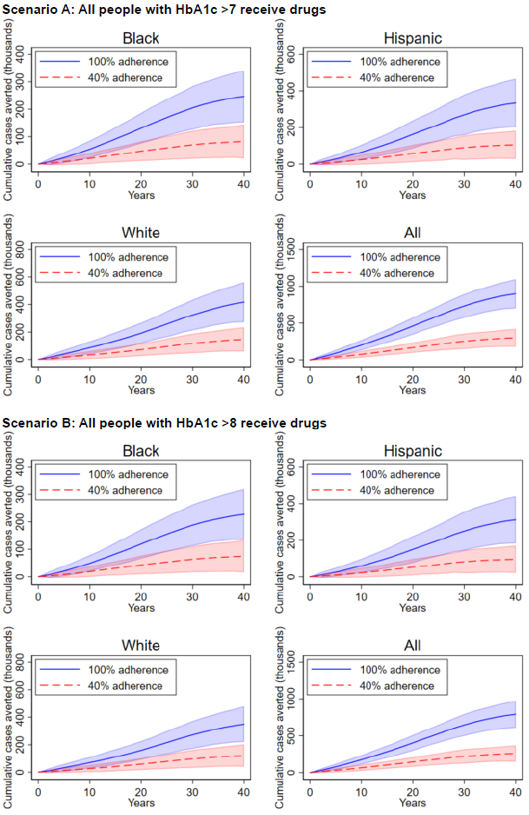
Cumulative ADRD cases averted over 40 years from increased use of GLP-1 receptor agonists and SGLT2 inhibitors, by race and ethnicity, under 100% and 40% adherence. Scenario A treats everyone with HbA1c above 7; Scenario B treats everyone with HbA1c above 8.