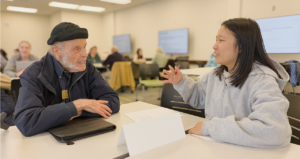
 At the UW School of Pharmacy, older adults from University House Wallingford and Era Living help students build confidence, strengthen communication skills and better understand what matters most in caring for older adults.
The room may look like an ordinary classroom, with students seated at tables and conversation rising in a low, steady hum. But on Patient Interview Day at the University of Washington School of Pharmacy, the atmosphere feels more personal than instructional. There are no mock cases or scripted scenarios here. Instead, older adults from University House Wallingford, one of Era Living’s seven Seattle-area Retirement Communities, sit down with student pharmacists to talk about their lives, their health and what matters most to them.
For students completing the Plein Certificate in Geriatric Pharmacy, the experience offers something difficult to teach through lectures alone: the chance to practice care as a human relationship.
According to organizer and Plein Center for Aging Assistant Director for Outreach and Associate Teaching Professor Abby Winter, the event, now in its second year, is designed to help students build confidence before they begin clinical rotations, while deepening their understanding of what it means to care for older adults with skill, empathy and respect.
“The goal is to give students an opportunity to speak with and interview older adults so that, when those conversations become part of clinical practice, they feel familiar and natural,” she said.
Another primary purpose for the program, says Winter, is helping students understand that communication is central to good care.
“We work so much on the intricacies of each medicine and how things work in the body,” she noted, “but I think one of the most important things is the communication. If you can’t communicate all that knowledge you have, or understand someone else’s concerns, you’re not going to be a great practitioner.”
Learning beyond the medication list
At the heart of Patient Interview Day is a simple but important idea: caring well for older adults begins with listening. Winter encourages students to focus not only on medications and medical histories, but also on the rhythms and priorities that shape a person’s daily life — family, friendships, independence, favorite routines and the things they most want to preserve.
The goal is not simply to collect information. It is to understand that good care begins with knowing who a person is and what matters to them.
In a profession that asks students to master complex science and clinical decision-making, Patient Interview Day makes space for something quieter, but no less essential: presence, curiosity and trust. It reminds students that expertise matters most when it is paired with the ability to connect.
A partnership that invites older adults into the classroom
For University House Wallingford, the partnership carries meaning of its own. Phyllis Fischer, executive director of the community, said many residents are drawn to the experience because they value hands-on, real-world learning and welcome the chance to contribute to the education of future pharmacists.
“Many of our residents are retired teachers, professors and longtime volunteers,” she said. “Some are curious about pharmacists and the role they can play in patient care. Others are simply interested in the opportunity to spend time with students and take part in something new.”
For residents, the experience also offers something that can be unexpectedly rare: focused attention. Fischer said one of the most meaningful aspects of the day is the opportunity to have someone actually listen to residents’ stories or their concerns, and having the focus be on them exclusively for a short time.
“I also see the value of intergenerational exchange,” she said. “Older adults can help students understand concerns that may not always be visible in a textbook — independence, mobility, isolation, family, resources and the ability to continue making choices about one’s own life.”
Fischer’s hope is that students leave the event seeing older adults as “interesting and credible”, and that they will feel more comfortable approaching and engaging with much older people throughout their careers.
What students carry forward
For Katie Daugherty, a UW PharmD student, the experience offered both perspective and reassurance. She came into the event a little nervous, unsure whether she would be able to keep the conversation going. But she also knew the residents genuinely wanted to be there and wanted to talk with students, which helped put her at ease. Once the conversation began, she found that it unfolded naturally.
“Even though I didn’t talk a lot, my partner shared so much about their life and experiences,” she said. “It was incredibly valuable.”
What stayed with Daugherty afterward was the resident’s individuality — the details of a life that extended far beyond health care. She was struck by how active and engaged residents were in their community, and by the stories they shared about jazz clubs, themed celebrations and other resident-led activities. The experience reinforced something important: older adults want to be seen as individuals with interests, independence and full lives, not simply as patients.
The conversation also deepened her understanding of trust.
“Building trust starts with being present and really listening,” Daugherty said. “Once trust is there, people open up more.”
That lesson, she said, sharpened her understanding of patient-centered care — not as an abstract ideal, but as something built in real time, through attention, empathy and responsiveness to what a person values.
Perhaps most meaningfully, the day changed the way she thought about her own role.
“This experience reinforced how important it is to get to know the person and determine what matters to them, both their health and their personal life, so that we can best care for them,” she said.
One of her strongest takeaways was also a personal one: “Even as a quieter person, I could still have a meaningful and effective interaction.”
A lesson that stays with students
Patient Interview Day helps students strengthen communication skills, think clinically in the moment and become more comfortable engaging with older adults. But its value runs deeper than that. By bringing students and older adults together in conversation, the experience asks future pharmacists to practice one of the most important parts of care: making room for another person’s story.
In that sense, the lesson is both practical and lasting. Before pharmacists can help people manage medications, navigate side effects or make informed decisions about treatment, they first have to understand the lives those decisions are meant to support. Patient Interview Day offers students that understanding in the most direct way possible — by teaching them to listen first.